



IL-22
IL-22 is a member of the IL-10 cytokine family that primarily mediates communication between immune cells and epithelial tissues[1][2]. Produced by multiple leukocyte subsets, including Th17, Th22, γδ T cells, and innate lymphoid cells, IL-22 signals through a heterodimeric receptor complex expressed mainly on non-hematopoietic cells[2][3][4]. Mechanistically, IL-22 activates the STAT3 pathway in epithelial cells, promoting anti-apoptotic, pro-proliferative, and tissue-regenerative responses[1][3]. In the gastrointestinal tract, IL-22 enhances epithelial barrier function by stimulating mucus secretion, antimicrobial peptide production, and epithelial cell proliferation, which contributes to protection against infections and supports tissue repair[5][6][7]. Compared with IL-17, IL-22 exerts more regenerative and protective effects rather than pro-inflammatory responses in epithelial tissues[8]. Dysregulation of IL-22 has been implicated in autoimmune diseases, such as rheumatoid arthritis, multiple sclerosis, and inflammatory bowel disease, where aberrant signaling can exacerbate tissue pathology[9][6]. In experimental models, IL-22 administration promotes tissue repair in lung injury, pancreatitis, and liver damage, while receptor-specific antagonists allow precise modulation of IL-22-driven responses[1][10][11]. Therapeutic strategies targeting IL-22, including recombinant cytokines and IL-22 binding protein modulation, are being explored for chronic inflammatory disorders and gastrointestinal acute graft-versus-host disease[2][12][11].
References:
- [1]. Zenewicz LA. IL-22: There Is a Gap in Our Knowledge. Immunohorizons. 2018 Jul 5;2(6):198-207. doi: 10.4049/immunohorizons.1800006. PMID: 31022687; PMCID: PMC10518850. et al. IL-22: There Is a Gap in Our Knowledge. Immunohorizons. 2018 Jul 5;2(6):198-207. [Content Brief]
- [2]. Kiros M, et al. Trends in HIV-1 pretreatment drug resistance and HIV-1 variant dynamics among antiretroviral therapy-naive Ethiopians from 2003 to 2018: a pooled sequence analysis. Virol J. 2023 Oct 25;20(1):243. [Content Brief]
- [3]. Mühl H, et al. IL-22 in tissue-protective therapy. Br J Pharmacol. 2013 Jun;169(4):761-71. [Content Brief]
- [4]. Mühl H, et al. IL-18/IL-18BP and IL-22/IL-22BP: Two interrelated couples with therapeutic potential. Cell Signal. 2019 Nov;63:109388. [Content Brief]
- [5]. Zenewicz LA, et al. Recent advances in IL-22 biology. Int Immunol. 2011 Mar;23(3):159-63. [Content Brief]
- [6]. Ulu A, et al. IL-22 regulates inflammatory responses to agricultural dust-induced airway inflammation. Toxicol Appl Pharmacol. 2022 Jul 1;446:116044. [Content Brief]
- [7]. Mohty M, et al. IL-22, a new beacon in gastrointestinal aGVHD. Blood. 2023 Mar 23;141(12):1369-1370. [Content Brief]
- [8]. Liang SC, et al. IL-22 induces an acute-phase response. J Immunol. 2010 Nov 1;185(9):5531-8. [Content Brief]
- [9]. Dean LS, et al. I don't know about you, but I'm feeling IL-22. Cytokine Growth Factor Rev. 2024 Dec;80:1-11. [Content Brief]
- [10]. Li J, et al. IL-22, a vital cytokine in autoimmune diseases. Clin Exp Immunol. 2024 Nov 12;218(3):242-263. [Content Brief]
- [11]. Keir M, et al. The role of IL-22 in intestinal health and disease. J Exp Med. 2020 Feb 13;217(3):e20192195. [Content Brief]
- [12]. Eyerich S, et al. IL-17 and IL-22: siblings, not twins. Trends Immunol. 2010 Sep;31(9):354-61. [Content Brief]
-
IL-22 Related Products (11)
Related Products (11)

- 1
-
Fezakinumab
 0 ImagesSynonyms: ILV 094Fezakinumab (ILV 094) is an anti-IL-22 monoclonal antibody. Fezakinumab inhibits IL-22 signal transduction, and regulates the JAK1/STAT3 pathway as well as apoptotic proteins. Fezakinumab alleviates airway remodeling, alveolar enlargement and inflammatory cell infiltration in lung tissues. Fezakinumab reduces the levels of neutrophils, lymphocytes, eosinophils and macrophages in lung tissues. Fezakinumab can be used in the research of chronic obstructive pulmonary disease and skin diseases.
-
Temtokibart
 0 ImagesSynonyms: ARGX-112; LEO-138559; LP-0145Temtokibart (ARGX-112) is a monoclonal antibody and also an IL-22RA1 inhibitor. Temtokibart inhibits the signal transduction of IL-22, IL-20 and IL-24. Temtokibart reduces the expression levels of inflammatory proteins, chemokines, immune cell migration and markers of activated immune pathways. Temtokibart improves the expression of genes related to immunity and epidermal barrier function. Temtokibart is applicable to research on moderate-to-severe atopic dermatitis.

-
Hesperetin 7-O-glucoside
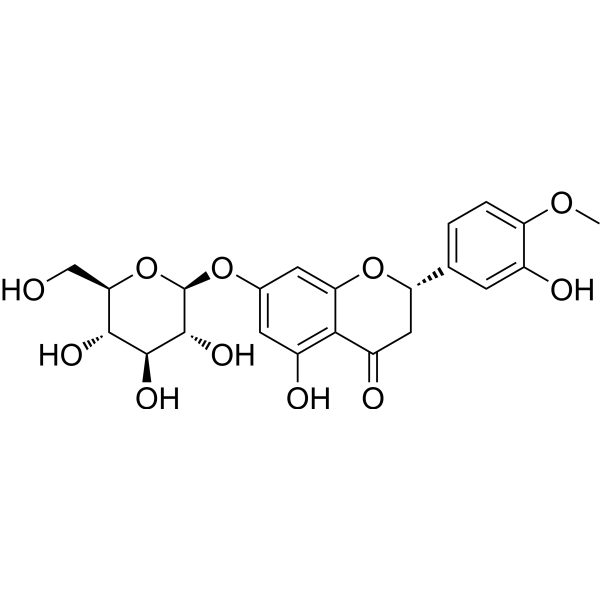 0 ImagesSynonyms: Hes-7-GHesperetin 7-O-glucoside is a typical flavonoid monoglucoside, which is an anti-inflammatory agent and an antihypertensive with orally active. Hesperetin 7-O-glucoside is a commonly used food adjuvant. Hesperetin 7-O-glucoside inhibits human intestinal maltase and human HMG-CoA reductase with Ki of 1.8 mM and 9.8 μM, respectively. Hesperetin 7-O-glucoside has antibacterial activity and can regulate intestinal flora and metabolic homeostasis in mice.
-
PY109
 0 ImagesPY109 is an orally active and highly selective aryl hydrocarbon receptor (AHR) agonist. PY109's EC50 values in human-derived HepG2 and mouse Hepa-1c1c7 cells are 1.2 nM and 1.4 nM respectively. PY109 significantly upregulates the expression of CYP1A1 and IL-22, and inhibits the expression of IL-17A. PY109 significantly improves colitis in mice. PY109 can be used for research on colitis.
-
PI3K/AKT/JAK2-IN-1
 0 ImagesCat. No.: HY-184385PI3K/AKT/JAK2-IN-1 is a potent multi-target inhibitor of the PI3K/AKT/JAK2 signaling pathway. PI3K/AKT/JAK2-IN-1 suppresses NO production (IC50 = 1.0 μM), reduces pro-inflammatory cytokines (TNF-α, IL-6, IL-1β, IL-17A, IL-22), and inhibits keratinocyte hyperproliferation by downregulating Ki67 and PCNA. PI3K/AKT/JAK2-IN-1 can be used for psoriasis research.
-
APG-2305
 0 ImagesCat. No.: HY-P12213APG-2305 is a selective IL-23 receptor inhibitor. APG-2305 inhibits IL-23-induced STAT3 phosphorylation, reduces the expression of pro-inflammatory cytokines (IL-1, IL-6, IL-22) without altering IL-17 levels, and alleviates inflammation in multiple in vivo models. APG-2305 is used for research on inflammatory autoimmune diseases.
-
PROTAC IRAK4 degrader-13
 0 ImagesPROTAC IRAK4 degrader-13 (Degrader 1) is a selective IRAK4 PROTAC degrader with DC50s of 0.86 and 1.1 nM for monocytes and lymphocytes in PBMCs, respectively. PROTAC IRAK4 degrader-13 significantly induces TIR signal activation, and inhibits the expression of circulating proinflammatory cytokines in Imiquimod (HY-B0180) induced psoriasis mice model. PROTAC IRAK4 degrader-13 can be used for TLR- and IL-1R-driven driven neutrophilic inflammation diseases like hidradenitis suppurativa (HS) and atopic dermatitis (AD) research. Pink: IRAK4 ligand; Blue: E3 ligase ligand; Black: linker
-
Donzakimig
 0 ImagesSynonyms: UCB-1381Donzakimig is a trispecific anti-IL-13/IL-22/HSA antibody. Donzakimig adopts a Fab-scFv-scFv structural format (without an Fc region), in which the Fab domain is linked to the scFv domains via a S (G4S)2 linker. Donzakimig binds to and inhibits the activities of IL-13 and IL-22, thereby blocking the signal transduction of these two cytokines. Donzakimig can extend its serum half-life by binding to human serum albumin, enhancing its in vivo stability and achieving long-acting efficacy. Donzakimig can be used in research on moderate-to-severe atopic dermatitis, moderate-to-severe asthma (especially eosinophilic type), psoriasis, inflammatory bowel disease, and other conditions.
-
RORγt inverse agonist 35
 0 ImagesCat. No.: HY-176273RORγt inverse agonist 35 (Compound 22) is a RORγt inverse agonist with an IC50 of 1.51 μM. RORγt inverse agonist 35 significantly inhibits Th17 differentiation and proinflammatory properties in human CD4+ T cells. RORγt inverse agonist 35 can be used for research of Th17-driven autoimmune diseases, such as psoriasis, multiple sclerosis, and inflammatory bowel disease (IBD).
-
Anti-CD1a Antibody (OKT-6)
 0 ImagesCat. No.: HY-P990869Anti-CD1a Antibody (OKT-6) is an anti-human CD1a IgG1 monoclonal antibody. Anti-CD1a Antibody (OKT-6) blocks T cell activation by blocking CD1a function. Anti-CD1a Antibody (OKT-6) can reduce the production of IFN-γ. Anti-CD1a Antibody (OKT-6) can be used for researches on cancer and inflammation such as leukemia. The recommend isotype control of Anti-CD1a Antibody (OKT-6): Mouse IgG1 kappa, Isotype Control (HY-P99977).
- 1



